Rütli Oath
William TellThe Rütli Oath turns a political compact into a collective act performed before witnesses: representatives of the three cantons renew what they describe as an ancient agreement, then pledge to remain united in danger and death. Its staged movement from night toward daybreak, and its carefully arranged swords, circle, gestures, and repeated words, give visible form to the community the oath is meant to bind. The scene defines freedom not as isolation from all authority, but as inherited self-government joined to common defense and resistance to tyranny.
Background and Political Claims
The oath is presented not as the creation of a new alliance but as the renewal of one made by the participants’ fathers in earlier times. That distinction grounds their action in continuity: they claim to restore an existing bond rather than invent a right to resist in the moment. Stauffacher articulates this position as the gathering considers what the alliance means, giving the ceremony both a historical foundation and an immediate political purpose.
The speakers describe the cantons as having preserved their freedom from the beginning and never bowed to princes. At the same time, they acknowledge that they freely sought the protection of the Holy Roman Empire, and that this protection was freely granted. Rosselmann supports the claim by referring to Emperor Frederick’s charter. The account therefore does not equate freedom with an absence of every political obligation: Stauffacher recognizes a feudal lord and a supreme judge to whom disputes may be appealed.
The stated reciprocal duty is limited and specific. The free communities are bound to aid the empire with their swords in war, and Stauffacher presents that service as the freeman’s duty to defend the power that protects him. This argument separates an acknowledged imperial relationship from the coercive authority they oppose. The oath’s political reasoning depends on that distinction: inherited rights and legitimate obligations remain, while tyranny is to be resisted.
Ceremonial Form and Participants
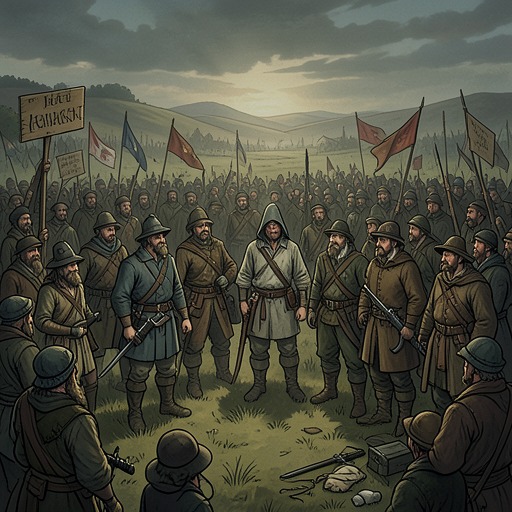
The scene gives the gathering a physical order before it gives the oath its words. Rosselmann calls for a ring to be formed and for the swords of power to be planted in the ground. The stage direction then places two swords before the assembled group and arranges the circle with the Canton of Schwyz in the center, the Canton of Uri on its right, and the Canton of Unterwalden on its left. The arrangement makes the three communities distinct within the formation while bringing them into one shared space.
Stauffacher enters the circle to explain the alliance’s meaning. Other participants answer and extend their hands to either side; the gathered men join hands and affirm their common identity. The action is not merely illustrative. The linked circle enacts the solidarity the speeches declare, making mutual commitment visible among people who will soon swear to act together.
The oath itself unfolds in repeated, shared gestures. As the night wanes, those present take off their caps and contemplate the breaking day in absorbed silence. Rosselmann then calls for the oath of the confederacy. The participants repeat his pledges with three fingers raised, and, after the final vow, embrace one another. The sequence moves from silence and attention to spoken commitment, synchronized gesture, and physical fellowship. Its collective form leaves no single speaker as the sole owner of the pledge: Rosselmann initiates the words, but the group repeats and assumes them.
The Vows and Their Immediate Purpose
The central promise is that the participants will be a nation of true brothers and will never part in danger or death. A second vow declares that they will remain as free as their forebears and would rather die than live in slavery. A third places their trust in God Most High and rejects fear before human power. Taken together, these pledges bind the participants to one another, to inherited freedom, and to a source of moral confidence beyond the rulers they challenge.
The oath is also connected to a practical decision about what to do next. Furst frames the objective as shaking off a hated thraldom and keeping ancient rights inviolate. When the gathering considers the limits of its action, he insists that they will do what necessity requires, but no more: they will drive out the tyrants and their agents and raze their towering strongholds. The vow therefore accompanies a plan to remove the instruments of oppressive rule, while its stated limit resists presenting the enterprise as an unlimited claim to power.
This combination of communal pledges and defined action matters to the scene’s political argument. The participants do not announce that every form of authority is illegitimate; they have already distinguished freely accepted imperial protection and customary duties from tyranny. Their agreement instead joins preservation of inherited rights with collective action against rulers and agents whom they judge to have violated them.
Ritual, Freedom, and Dramatic Aftermath
The play places the oath within a wider pattern of political ceremony. Earlier, a crier speaks in the emperor’s name and orders the men of Uri to look at a cap that is to be set on a lofty pole in Altdorf’s market-place. That commanded display makes obedience public: the cap stands for authority, and the demand to acknowledge it turns submission into a visible act. At the oath, by contrast, the participants’ joined hands, raised fingers, and repeated words display a bond they choose among themselves.
A later scene reverses the meaning of the cap’s public display. Girls bring it in on a pole before a stage filled with people, and Furst argues that it should be preserved rather than burned: once an instrument of despots, it can become a lasting symbol of freedom. The object’s return gives the oath’s political distinction a theatrical echo. A sign first associated with compelled recognition can be retained and reinterpreted by the community that has broken the rulers’ hold over it.
The Rütli Oath thus works both as an agreement and as a performance of collective identity. Its ancient compact, carefully ordered circle, repeated vows, and shared gestures make a political community visible to itself. The oath’s force lies not only in what its participants promise, but in how they enact the difference between authority imposed from above and solidarity affirmed among equals.